

For a business owner or manager struggling with solar contractor working capital cash flow problems, scaling your company or operations present a painful situation. Your project pipeline looks highly profitable on paper, yet actual active bank accounts are drowning.
Many founders and CFOs reflexively point fingers at macro-economic changes, shifting dealer fees, or sluggish utility Permission to Operate (PTO) cycles to explain their mid-project cash flow crunches. But the real leak isn’t happening out in the field, it is happening right on your accounting books. The company’s hard-earned liquidity is being choked out by a silent, internal bottleneck: manual accounts payable friction.
The Compounding Cost of Manual Back-Office Friction
When your finance team relies on traditional, manual workflows to process supplier invoices, a dangerous chain reaction occurs. Industry benchmarks reveal that manual processing takes 6 to 14-day operational lag per invoice batch, as per Tradogram. Instead of matching bills in real-time, your office sits on a pile of unverified papers, blinding your books with true accrued liabilities.
This processing delay actively breeds systemic mistakes. As local accounting staff rush to clear backlogs, human data entry errors increase. According to fiscaltech.com, a staggering 39% of all manual corporate invoices contain filing or documentation errors, ranging from missing structural plan stamps, incorrect billing information to duplicate charges.
The compounding penalty affects your cash flow twice negatively. First, the initial 7 to 14-day processing bottleneck stalls project velocity and delays developer milestone payouts. Second, trying to fix those errors swallows up of your onshore accounting team’s monthly labor capital. The result? Un-reconciled invoices freeze your Tier-1 distributor credit lines, material shipments are placed on hold, and your field crews are left waiting on a job site while your capital sits frozen in pipeline purgatory.
How An Accounts Payable VA Can Help Unfreeze Working Capital Friction
To fix solar contractor working capital cash flow problems, executives must first recognize a fundamental reality, a solar installer’s liquidity crisis rarely begins in the sales department. It begins on the accounting desk.
On paper, a residential or commercial EPC (Engineering, Procurement, and Construction) project appears highly lucrative. Contract values are locked, customer deposits are collected, and projected margins look healthy. However, between the moment a project is signed and the date the utility grants Permission to Operate (PTO), a solar contractor must fund significant out-of-pocket costs—including structural engineering stamps, racking, solar modules, inverters, and field installation labor.
When back-office processing cannot keep pace with procurement speed, a severe operational bottleneck occurs.
The Three-Way Matching Bottleneck
In a standard construction accounting environment, accounts payable staff must perform a three-way match before paying an invoice:
- The Supplier Invoice: The bill sent by the distributor or equipment vendor.
- The Purchase Order (PO): The original cost estimate generated by the procurement team.
- The Receiving Log / Delivery Receipt: Proof from the field crew or warehouse that the hardware was delivered to the job site.
When performed manually, this verification process stalls. While paper invoices sit on desks awaiting manual approval, your financial records lack visibility into true accrued liabilities. The business operates with an inaccurate view of its real-time cash position.
Why the Remote Accounts Payable VA Strategic Fix Rather Than A Bandaid
The traditional response to AP backlogs, hiring additional expensive local bookkeepers or taking on high-interest supply chain debt, only to continue to burn the margin thin. The sustainable solution is hiring a dedicated Remote Accounts Payable Virtual Assistant (AP VA).
An Accounts Payable VA acts as a specialized extension of your finance department, taking 100% ownership of daily invoice management, data entry, and vendor communications.
Here’s why:
1. Daily Real-Time Bill Capture & 3-Way Reconciliation
Rather than letting invoices accumulate into weekly backlogs, a dedicated AP VA ingests, categorizes, and verifies supplier bills daily. By executing real-time three-way matching directly inside your ERP or accounting software, the VA eliminates the 7 to 14-day processing lag and maintains accurate, live tracking of accrued liabilities.
2. Proactive Exception & Error Elimination
Because an AP VA is focused exclusively on payables processing without local administrative distractions, accuracy increases dramatically. Discrepancies in line-item quantities, missing tax exemptions, or purchase order mismatches are identified, flagged, and resolved immediately before payment authorization, eliminating penalties and billing errors.
3. Protecting Vendor Credit Lines & Shipment Velocity
When an Account Payable VA keeps invoice reconciliation moving synchronously:
- Distributor Credit Holds Are Prevented: Accounts remain current within net-30 or net-60 terms.
- Material Shipments Proceed Without Delay: Staging yards release panels, racking, and inverters on schedule.
- Field Crews Stay Productive: Installation teams receive equipment on-site without expensive downtime.
- Milestone Disbursements Accelerate: Project completion documentation is filed quickly, triggering rapid lender payouts and developer milestone releases.
Strategic Advantage Beyond Cost, How an AP VA Transforms Solar Operations
While reducing operational overhead is a standard efficiency, viewing a Remote Accounts Payable VA solely as a cost-saving measure misses the larger strategic transformation. The true value of integrating a dedicated AP VA into your solar company lies in operational focus, accuracy, scalability, and speed, beyond cost savings.
When your back office transitions from reactive, manual fire-fighting to a streamlined, process-driven engine, the ripple effects benefit every department across your organization

Reclaiming Strategic Bandwidth for Onshore Finance Leaders
High-value CFOs, controllers, and finance managers spend hours manually inputting invoice data, hunting down missing PO receipts, and fixing line-item discrepancies. By delegating the end-to-end accounts payable workflow to a specialized Remote AP VA, your onshore finance leaders can pivot from manual data entry to high-impact financial management:
- Negotiating better credit terms with equipment distributors.
- Optimizing cash conversion cycles and working capital reserves.
- Evaluating project profitability and job-costing metrics.
- Managing lender and tax-equity investor relationships.
High-Precision Accuracy Through Dedicated Focus
Onshore office managers are constantly interrupted by local office logistics, field crew phone calls, customer inquiries, and walk-ins. When data entry occurs in an environment filled with constant context-switching, mistakes inevitably happen.
A dedicated Remote Accounts Payable VA operates in a focused environment structured entirely around standardized operating procedures (SOPs). Because your Account Payable VA’s sole focus is verifying invoices, auditing line items, and executing three-way matches, your books remain audit-ready and virtually error-free.
Elastic Scalability to Match Installation Volume Spikes
Solar installation demand is inherently cyclical. Year-end tax incentives, utility rate changes, and favorable weather windows create massive surges in installation volume.
Scaling a traditional onshore accounting team to handle seasonal volume spikes is slow, rigid, and costly. When invoice volume doubles during Q3 and Q4 pushes, an un-assisted back office quickly buckles under the backlog.
A Remote Accounts Payable VA framework provides instant operational elasticity:
- Seamless Ingestion: Effortlessly absorbs unexpected spikes in weekly supplier invoices without operational lag.
- Zero Recruitment Friction: Avoid the lengthy 60-day hiring, onboarding, and training cycles required for local administrative positions.
- Continuous Workflow: Maintain smooth processing momentum year-round, ensuring your cash flow engine never stalls during peak installation months.
Turning Tier-1 Distributors into Strategic Partners
In the solar industry, equipment availability can make or break a company’s execution schedule. Distributors naturally favor contractors who pay reliably, communicate proactively, and resolve billing questions smoothly.
When an Accounts Payable VA manages vendor statement reconciliations and proactive payment scheduling:
- Statements Are Audited Weekly: Potential billing disputes are caught and addressed immediately, preventing surprise past-due flags.
- Communication Is Consistent: Vendors receive prompt, clear updates regarding payment status and missing documentation.
- Preferred Customer Status: Your firm builds a reputation as an elite, dependable partner, earning priority allocation for hard-to-source modules, inverters, and racking during industry-wide supply chain shortages.
Why Specialization Beat Generalist VAs
When solar executives decide to optimize their financial back office, a common pitfall is hiring a generic “virtual assistant” to manage complex accounting workflows. Construction accounts payable is not standard administrative work. The job post requires strict attention to detail, familiarization with purchase order (PO) structures, and an understanding of solar supply chain mechanics.
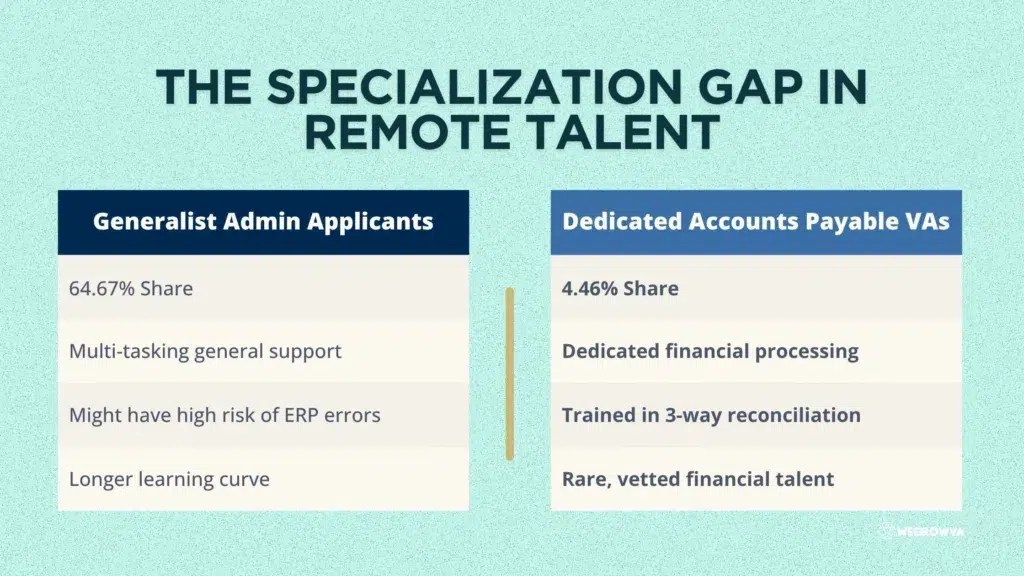
To understand why specialized execution matters, here’s WeGrow VA’s internal talent database spanning from 2022 through 2026. The data reveals a reality about the offshore remote workforce:
The 14.5 to 1 Generalist-to-Specialist Ratio
Out of the 64.67% classified themselves as generalist Admin VAs. In contrast, true Accounts Payable VAs represent just 4.46% of the total historical talent pool.
This means that for every 1 specialized Accounts Payable VA, there are nearly 15 general administrative workers.
When solar contractors attempt to route vendor invoices, three-way matching, and job-costing through a generalist administrative VA, error rates spike. A generalist VA is structured for calendar management and inbox filtering, not for catching a misapplied sales tax exemption on a $100,000 inverter shipment or auditing line-item quantities against site receiving logs.
Why WeGrow VA Filters for the Top 4.46%
Because specialized AP talent represents a focused segment of the remote workforce, sourcing the right professional requires a dedicated vetting pipeline.
During peak talent acquisition windows, our recruitment architecture isolates candidates with direct experience in:
- Deep familiarity with construction & solar ERPs.
- Auditing supplier bills against purchase orders and warehouse logs with zero room for keystroke errors.
- Directly liaising with Tier-1 distributors to resolve billing discrepancies before credit lines are impacted.
By accessing WeGrow VA’s curated pool of specialized Accounts Payable Virtual Assistants, solar contractors avoid the trial-and-error of generalist hiring. You gain immediate access to vetted financial talent trained to protect your working capital from day one.
Unfreeze Your Working Capital with WeGrow VA
Solving solar contractor working capital cash flow problems doesn’t require taking on expensive debt or sacrificing your operational margins. It requires fixing the internal bottleneck that stalls your liquidity: your back-office accounts payable friction.
By deploying a dedicated, highly trained Remote Accounts Payable Virtual Assistant from WeGrow VA, you can eliminate processing lags, prevent costly errors, protect your distributor credit lines, and free up your executive team to scale the business.
Ready to Build a High-Velocity Back Office?
Stop letting manual invoice friction trap your working capital in pipeline purgatory. Partner with WeGrow VA to integrate a dedicated Accounts Payable expert tailored to your accounting software, workflows, and growth targets.
👉 [Schedule Your Free Operational Strategy Session with WeGrow VA Today] — Let’s audit your back-office workflows and build a tailored remote talent strategy to keep your liquidity moving and your field crews working.
